

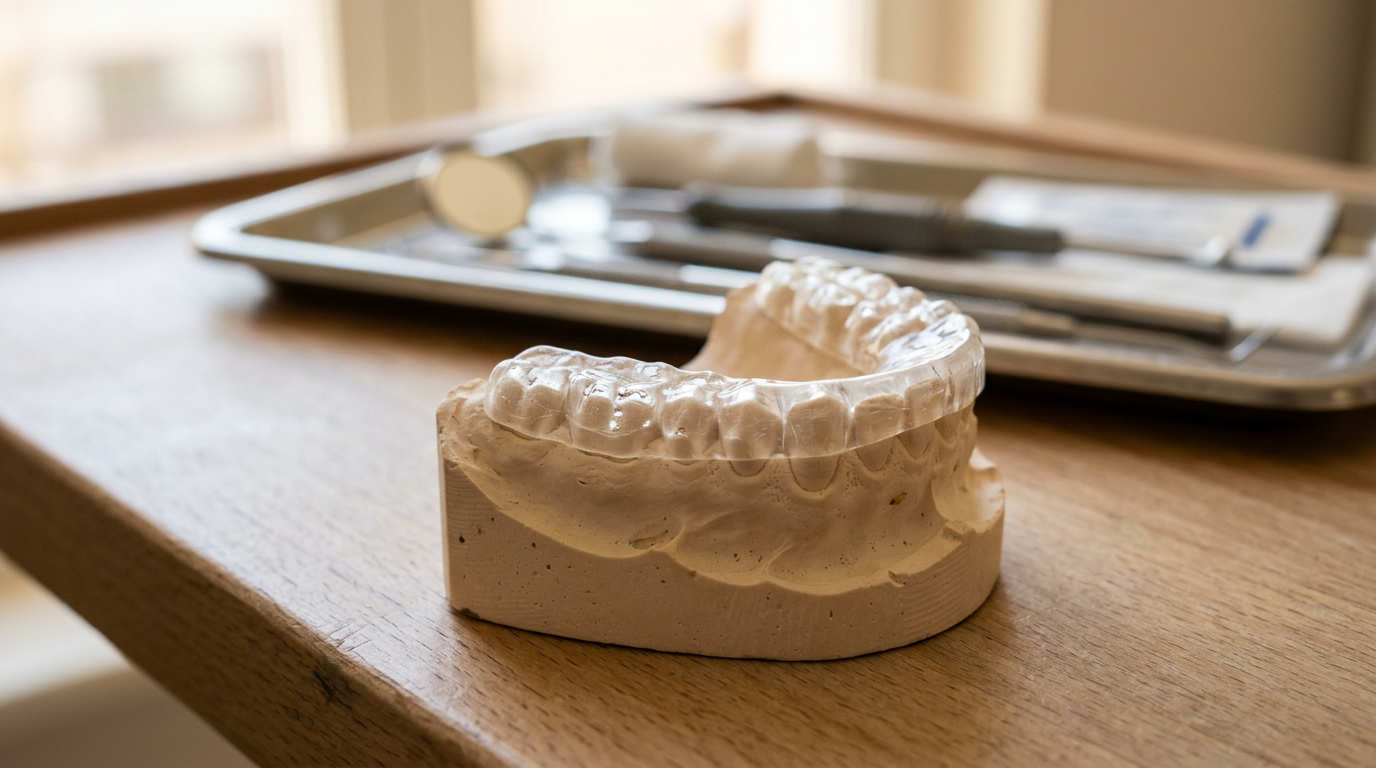
A night guard is a custom intraoral appliance commonly used by people who clench or grind their teeth. It generally fits over the upper or lower teeth during sleep.
It may also be called a clenching guard, grinding guard, bruxism guard or dental protective appliance.
Its main role is to reduce uncontrolled direct friction between teeth, protect them from excessive forces and, in some patients, help manage loading on the chewing muscles and joint.
A night guard does not treat every clenching problem on its own.
It can be helpful when correctly selected, designed, fitted and regularly reviewed. An unsuitable, poorly fitting, excessively soft or thick appliance, uneven contacts or unsupervised use may be ineffective or increase discomfort.
It should therefore be assessed in the context of clenching, joint, muscle and bite relationships, beyond simply being clear plastic worn over teeth.
What Does a Night Guard Do?
It mainly helps protect teeth during clenching and grinding. Clenching can produce loads above normal chewing forces, while grinding adds sliding friction. Over time this can affect teeth, muscles, joints and restorations.
A guard may offer the following support.
- Reduced direct tooth-to-tooth friction
- Slower tooth wear
- Reduced risk of enamel cracks and sensitivity
- Protection for fillings, crowns, veneers and zirconia
- More controlled muscle activity in some patients
- Support for management of joint loading
- Relief of morning fatigue in some patients
- Distribution of traumatic clenching forces
Effects vary with clenching severity, muscle activity, joint status, bite and appliance design.
Does It Stop Clenching?
It may reduce dental damage without eliminating the cause. It can protect teeth, reduce friction, distribute forces, support muscle comfort and help in selected TMJ cases.
Clenching may involve stress, sleep quality, nervous system activity, bite factors, muscle habits, medicines, breathing problems and lifestyle. A guard alone may therefore be insufficient.
Biofunctional assessment asks the following questions.
- Is clenching actually present?
- Is it more pronounced during sleep or while awake?
- Is there tooth wear?
- Are the muscles tender?
- Is there joint noise or pain?
- Is the bite balanced?
- Are restorations at risk?
- Is the goal protection, stabilisation or deprogramming?
The answers guide appliance type, hardness, thickness, arch and review schedule.
Who May Need One?
Assessment may be helpful for sleep clenching or grinding, morning fatigue or headaches, temple pain, worn, sensitive or cracked teeth, broken fillings, crowns, zirconia or veneers, tense jaw muscles, joint pain or noises, protection of implant-supported prostheses, or protection after smile design or full-mouth rehabilitation.
Examination comes first. A soft guard may be unsuitable for some patients, others may need a hard stabilisation splint, while joint problems or sleep and breathing assessment may take priority in others.
How Is a Night Guard Made?
Ready-made appliances often do not fit the individual teeth and bite precisely. A custom appliance is prepared after examination and accurate records.
Examination
The teeth, gums, joint, chewing muscles and bite are assessed, including wear, cracks, sensitivity, restorations and clenching signs.
Impressions or digital scans
An accurate impression or scan records the teeth and is important for fit.
Bite assessment
The relationship between the jaws is assessed. Some patients need a simple protective appliance, while others require more carefully designed occlusal splints.
Laboratory manufacture
The appliance is made to fit the teeth. Material, thickness and design follow the clinician’s plan.
Intraoral fitting
Seating, tightness, margins and comfort are checked in the mouth.
Bite adjustment
Balanced contacts are particularly important in hard splints. Adjustments may be needed.
Follow-up
Muscles, joint and tooth contacts can respond differently after use, so review is needed after delivery.
Upper or Lower Jaw?
Either arch may be selected according to anatomy, tooth alignment, bite, comfort, purpose and the clinician’s plan. Upper appliances may be more stable in some patients, lower ones more comfortable in others. Treatment goals may determine the choice. Correct design and balanced function are more important than the arch alone.
Hard or Soft?
Both materials are available, but suitability varies.
Soft night guards
They may feel comfortable, but some patients chew them more or experience an increased chewing response. They are not ideal for every clenching patient.
Hard night guards and splints
Hard appliances allow more controlled contacts. Stabilisation splints can be planned in greater detail for joint and muscle needs, but require correct preparation and review.
The appropriate design depends on the individual problem.
Is It the Same as a Splint?
The terms overlap in everyday use. A night guard broadly describes an appliance worn at night to protect teeth. A splint more specifically may account for controlled bite relationships and jaw position, often for therapeutic or stabilisation purposes.
A more detailed splint may be needed with jaw pain, TMJ problems, muscle pain or advanced bruxism.
Can It Help Jaw Pain?
It may help when pain relates to clenching, muscle fatigue or bite loading. Other causes include muscle pain, joint disorders, dental infection, sinus or ear problems, trauma, neurological pain, and neck or posture problems. The source should be assessed before prescribing an appliance.
Does It Straighten Teeth?
No. Orthodontic treatment or aligners move and align teeth. A night guard protects against clenching and grinding, while a splint may also help manage muscle, joint and bite relationships. These appliances have different purposes.
Does It Correct the Jaw?
It generally does not permanently change jaw structure or independently correct a retruded or protruding jaw, skeletal problems or orthodontic bite disorders.
A suitable splint may help muscles relax, balance joint loading or test a temporary position. It may provide functional comfort in selected patients.
Can It Cause Pain?
An unfamiliar feeling can occur initially. Marked pain, excessive pressure, worsening jaw pain or major bite discomfort requires review. Seek a check if the appliance is too tight, teeth hurt in the morning, jaw pain increases, insertion causes nausea or excessive discomfort, it moves or rubs the gums, the bite feels changed, or it develops holes or breaks quickly.
The appliance should be custom-made and adjusted when needed.
How Long Is It Used?
Use may be temporary or long-term. Relevant factors include clenching severity, wear, muscle and joint findings, restorations, implants or smile design, sleep and stress, appliance wear and review findings. Duration should be decided through follow-up rather than a fixed number of months for everyone.
How Is It Cleaned?
Poor cleaning can lead to odour, discolouration, bacterial accumulation and hygiene problems.
- Rinse after each use.
- Clean gently with a soft brush.
- Avoid very hot water, which can deform it.
- Follow advice on toothpaste, as it can scratch some materials.
- Store dry in a clean case.
- Use suitable cleaning tablets periodically when recommended.
- Keep it away from pets.
- Have cracks, breakage or deformation checked before further use.
Cleaning affects lifespan and comfort.
What About Ready-made Guards?
Boil-and-bite or standard-size guards may fail to seat fully, disturb the bite, put excessive pressure on some teeth, be unsuitable for muscle or joint problems, or produce uncontrolled forces during long-term use. They may not substitute for therapeutic splints.
Custom, professionally supervised appliances are preferable where clenching, pain, joint noises, wear or broken restorations are present.
Can a Guard Break?
Yes. Wear, cracks and breakage can develop. Heavy clenching may leave marks, scratches, thin areas or holes, providing information about forces.
Rapid breakage warrants assessment of clenching severity, material suitability, thickness, contact balance, the possible need for a hard splint, and underlying joint or muscle problems. A broken guard should be reviewed before reuse.
What Affects Cost?
Cost depends on type, material, impression method, laboratory process, adjustment needs, splint design and reviews. A simple protective guard differs from a carefully planned stabilisation splint.
Relevant questions include whether it is custom-made, hard or soft, whether bite adjustment and joint assessment are included, whether reviews are provided, whether it addresses bruxism or TMJ problems, and whether the purpose is protective or therapeutic.
A night guard is part of a clinical process requiring diagnosis and planning.
Is a Guard Enough?
Some patients obtain sufficient protection. Others need daytime awareness work, stress management, sleep assessment, bite analysis, splint treatment, jaw exercises, physiotherapy, restorative planning, rehabilitation of worn teeth or protection of implants and crowns. The appliance can be an important component without resolving every issue alone.
The Biofunctional Assessment
Planning considers wear patterns, joint status, muscle tenderness, bite contacts, clenching severity, restorations, implant or prosthesis risks, protection after smile design, comfort and changes at reviews.
The goal is to monitor the appliance’s effect on the whole system as well as supply it.
When May It Be Insufficient?
More comprehensive assessment may be needed for severe joint problems, active locking, advanced wear, loss of vertical dimension, very severe bruxism, suspected sleep apnoea, persistent head and neck pain, major bite problems, post-traumatic jaw pain, repeated fractures in implant-supported prostheses or previous guards that did not help.
When Should You See a Dentist?
Assessment is helpful for morning fatigue, awareness of clenching or grinding sounds, worn or cracked teeth, broken fillings or crowns, joint noises, jaw, head or temple pain, sensitivity, or protection of implants and aesthetic restorations. Early assessment may reduce damage.
Dr. Melih Şengül’s Approach
In Dr. Melih Şengül’s biofunctional approach, a night guard is an individual clinical tool. Teeth, joint, muscles, bite and restorative risks are assessed first. The goal may be tooth protection, muscle comfort, joint load management or a temporary or protective component of a wider plan. The quality of assessment behind the appliance is therefore central.
Conclusion — A Night Guard Within a Treatment Plan
A custom night guard may reduce clenching-related wear, cracks, sensitivity and restoration fractures. Correct planning matters because an unsuitable appliance may be insufficient. Planning should assess teeth, joint, muscles, bite, habits and overall function together, alongside taking impressions.
A night guard is a clinical application requiring diagnosis and individual planning.
Clinician’s note: This article provides general information. The same appliance or wearing schedule is not suitable for everyone. Jaw pain, wear, joint noises, headache or broken restorations require examination, bite analysis and joint assessment where needed.
Frequently Asked Questions
What is a night guard?
It is a custom intraoral appliance that helps protect teeth from clenching or grinding, usually worn during sleep.
What does a night guard do?
It reduces direct rubbing between teeth, may help slow wear, protect restorations and support more controlled muscle and joint loading in some patients.
Does it completely stop clenching?
Usually not. It can reduce harmful effects without always eliminating the underlying cause. Contributing factors should be assessed.
Is a night guard the same as a splint?
The terms are sometimes used interchangeably. Technically, a splint may be a therapeutic appliance designed for more controlled bite relationships and muscle-joint balance. Not every night guard is a therapeutic splint.
Can a night guard help jaw pain?
It may help some patients, especially with clenching-related or muscle-loading pain. Other causes should be assessed first.
Does it straighten teeth?
No. A night guard does not move teeth. Orthodontic aligners or braces are used to straighten them.
Does it correct jaw structure?
It generally does not permanently correct jaw structure. Some splints can help relieve muscle-joint strain or assess a temporary position.
How long is it used?
Duration depends on clenching severity, wear, muscle and joint findings and follow-up. Use may be temporary or long-term.
Can I use a ready-made guard?
Ready-made guards may not fit the teeth and bite precisely. Custom, professionally supervised appliances are preferable, especially with clenching, jaw pain or TMJ problems.
How is it cleaned?
Rinse after use, clean gently with a soft brush, avoid very hot water and store in a clean case. Use cleaning products recommended by your dentist.