

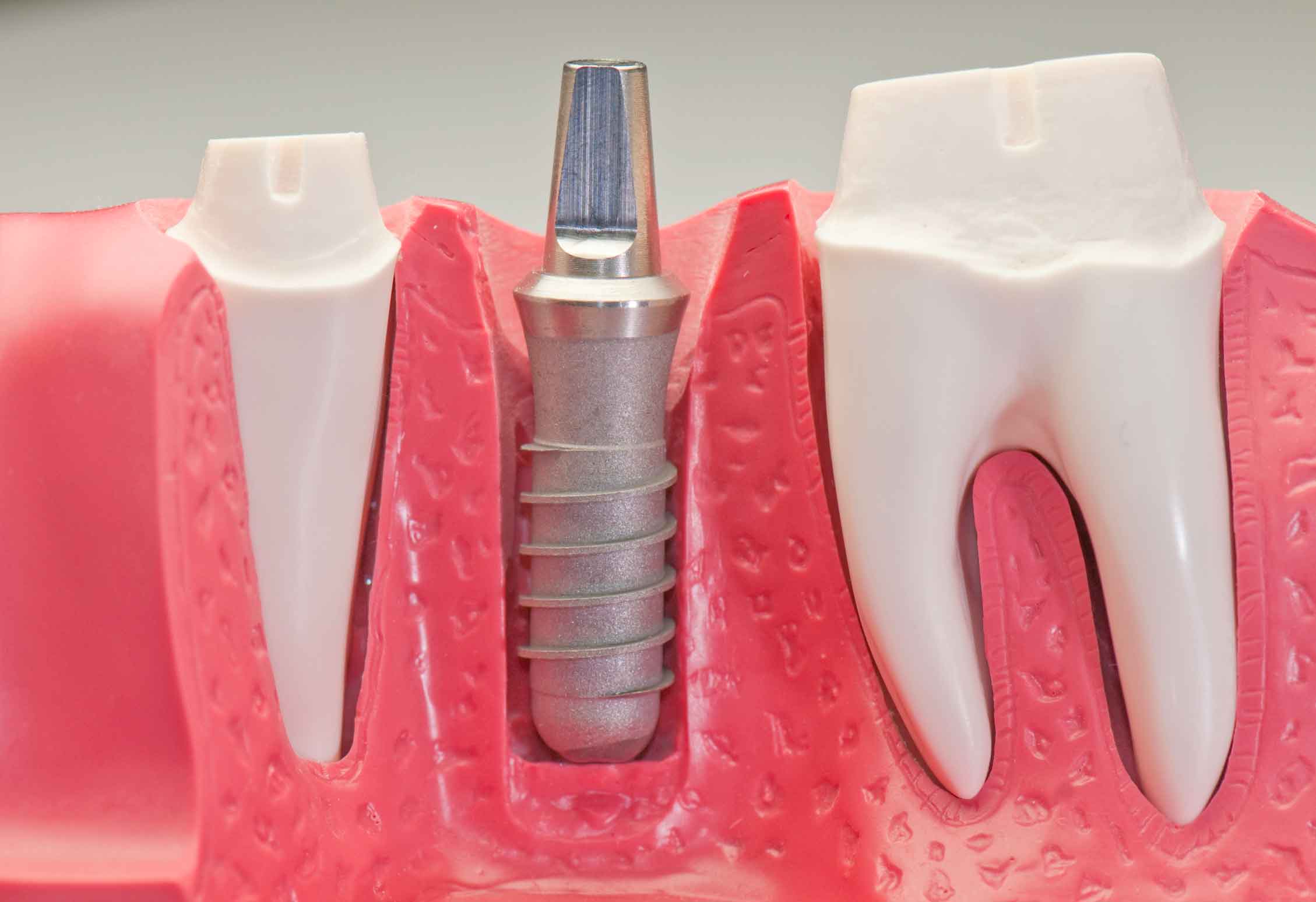
A single-tooth implant involves placing an implant in the jawbone where one tooth is missing and preparing a single-tooth restoration on it. In suitable patients, it can replace the missing tooth without preparing neighbouring teeth for a bridge.
However, I do not regard single-tooth implant treatment simply as filling a gap. The restoration replacing the missing tooth will work alongside the surrounding natural teeth. Its shape, contacts with opposing teeth, implant position and the health of surrounding tissues are important in treatment planning.
In my approach, the aim is to restore the appearance of the missing tooth while creating a restoration suited to the patient's existing chewing system.
What Is a Single-Tooth Implant?
A single-tooth implant is a fixed implant-supported restoration replacing one missing tooth.
The implant body is placed in the jawbone.
A single crown is prepared on the implant using suitable connecting components.
A crown is a restoration that replicates the part of a tooth visible in the mouth.
A single-tooth implant does not restore all the biological properties of a natural tooth.
However, under suitable conditions, it can help restore the appearance and chewing function of a missing tooth.
Why Does a Single Missing Tooth Matter?
One missing tooth does not have the same consequences for every patient.
However, in some situations neighbouring teeth may move towards the gap, or the opposing tooth may extend into it.
The bone structure at the missing-tooth site may change over time.
Missing front teeth, in particular, can affect appearance and certain aspects of speech.
Missing back teeth can alter the tooth contacts used during chewing.
Nevertheless, it is incorrect to say that every single missing tooth must be replaced with an implant.
The patient's existing tooth arrangement, functional needs and alternative treatments should be assessed together.
Who Is Suitable for a Single-Tooth Implant?
A single-tooth implant may be considered in patients with suitable bone and soft-tissue conditions at the missing-tooth site.
However, the presence of bone alone is not enough to determine suitability.
General health, oral hygiene, periodontal health and the condition of neighbouring teeth also matter.
Implant placement is generally postponed in patients who are still growing and developing.
Certain uncontrolled systemic diseases, smoking and particular medicines can also affect treatment planning.
What Is Assessed Before a Single-Tooth Implant?
Bone at the missing-tooth site
The bone volume and anatomical characteristics of the proposed implant site are assessed.
Condition of neighbouring teeth
The roots, positions and health of neighbouring teeth are examined.
Gums and soft tissues
Gum levels and soft-tissue volume can affect the aesthetic outcome, particularly in the front of the mouth.
Opposing teeth
How the implant-supported restoration will contact the opposing teeth is assessed.
The restoration replacing the missing tooth
The implant position should be assessed together with the planned shape and size of the tooth to be placed on it.
This approach can be described as prosthetically driven implant planning.
How Is a Single-Tooth Implant Placed?
1. Examination and imaging
The missing-tooth site is assessed clinically and radiographically.
Cone beam computed tomography (CBCT) may be used when necessary.
CBCT is an imaging method that enables three-dimensional assessment of the jawbones.
2. Treatment planning
The implant position and dimensions, and the restoration to be placed on it, are planned.
3. Necessary preparatory procedures
Additional procedures may be considered if bone or soft tissue is insufficient.
4. Implant placement
The implant is placed in the jawbone using a suitable surgical technique.
The procedure is usually performed under local anaesthesia.
5. Healing
A period of time may be required for the implant to integrate with bone.
6. Preparing the implant-supported tooth
A suitable connecting component and crown are prepared on the implant.
7. Reviews
The fit of the restoration, gum health and bite relationships are assessed.
How Do Front-Tooth and Back-Tooth Implants Differ?
Different considerations may be important when planning front-tooth and back-tooth implants.
Front-tooth implants
Aesthetic appearance is an important area of assessment in the front of the mouth.
Gum levels, harmony with neighbouring teeth and a natural-looking restoration are considered.
Bone and soft-tissue conditions can affect the aesthetic result, particularly for upper front teeth.
Back-tooth implants
Back teeth experience significant forces during chewing.
Implant position, the anatomy of the restoration and contacts with opposing teeth are therefore important.
However, front teeth should not be regarded as purely aesthetic, nor back teeth as purely functional.
Every tooth can have both aesthetic and functional roles.
How Long Does Single-Tooth Implant Treatment Take?
Treatment duration varies according to the patient's existing conditions.
In some suitable patients, an implant can be placed at the same appointment as tooth extraction.
In other cases, healing after extraction may need to be awaited.
A healing period may also be required after implant placement before proceeding to the restorative phase.
Bone augmentation procedures can extend the overall treatment duration.
Why Does the Anatomy of an Implant-Supported Tooth Matter?
The shapes of natural teeth are related to their roles during chewing.
For example, molars have cusps and grooves on their chewing surfaces.
These structures play a role in breaking down food and in contacts between teeth.
An implant-supported restoration also needs to be prepared according to the functional requirements of its location.
However, the anatomy of an implant-supported crown does not have to be an exact copy of a natural tooth in every situation.
Implant position, ease of cleaning, surrounding tissue characteristics and mechanical conditions can affect the design.
In my approach, what matters is understanding natural anatomy and using that knowledge in a way suited to the patient's existing conditions.
Why Does the Bite Matter for a Single-Tooth Implant?
Natural teeth are connected to surrounding bone through the periodontal ligament.
Implants do not have this structure.
The biomechanical responses of implants and natural teeth to forces therefore differ.
These differences should be considered when planning the bite relationships of an implant-supported crown.
Inappropriate mechanical conditions may, in some situations, be associated with complications such as restoration fracture or loosening of connecting components.
However, the bite alone does not determine the long-term success of an implant.
The health of tissues around the implant, oral hygiene and other biological factors also matter.
What Are the Advantages of a Single-Tooth Implant?
Preserving neighbouring teeth
In suitable cases, neighbouring teeth may not need preparation for a bridge.
Fixed restoration
The missing tooth can be replaced with a fixed implant-supported crown.
Aesthetic appearance
With suitable planning and tissue conditions, restorations approaching a natural appearance can be prepared, particularly for front teeth.
Chewing function
Replacing the missing tooth can contribute to the patient's chewing function.
What Are the Risks of a Single-Tooth Implant?
Implant surgery and the restorative phase involve certain risks.
These may include:
- Infection at the surgical site;
- Pain and swelling;
- Effects on neighbouring anatomical structures;
- Failure of the implant to integrate with bone;
- Inflammatory diseases around the implant;
- Mechanical problems with the crown or connecting components;
- Failure to meet aesthetic expectations, particularly for front teeth.
What Are the Alternatives to a Single-Tooth Implant?
Conventional dental bridge
The missing tooth is replaced using support from neighbouring teeth.
Adhesive bridge
A fixed restoration option that can be used with more limited tooth preparation in suitable cases.
Removable denture
This may be considered in certain clinical conditions.
Orthodontic space closure
For particular patterns of tooth loss, it may be possible to close the gap with orthodontic treatment.
Monitoring without treatment
In some patients, leaving the missing-tooth site unrestored and reviewing it regularly may also be considered.
Each option has advantages and limitations.
How Should a Single-Tooth Implant Be Cared For?
Regular cleaning of the tissues around the implant is important.
Toothbrushing and appropriate interdental cleaning should be maintained.
The implant-supported crown and surrounding tissues should be reviewed regularly.
The fact that an implant does not decay does not mean its surrounding tissues cannot develop disease.
When Should You Contact Your Dentist?
Contact your dentist if swelling, bleeding, discharge, increasing pain or movement of the restoration occurs around the implant.
Persistent numbness or uncontrolled bleeding after surgery also requires assessment.
What Affects the Cost of a Single-Tooth Implant?
Treatment cost depends on the implant system, extent of surgery, additional treatments required and characteristics of the implant-supported crown.
The scope of treatment may change, particularly in patients requiring bone augmentation or soft-tissue procedures.
A definite cost can be determined after examination.
Frequently Asked Questions
1. Does one missing tooth always require an implant?
No. Alternatives such as a bridge, adhesive bridge, orthodontic treatment or monitoring may also be considered.
2. Is a single-tooth implant painful?
The procedure is generally performed under local anaesthesia. Pain and swelling may occur afterwards.
3. How many appointments does a single-tooth implant require?
The number of appointments depends on the surgical and restorative stages. Additional procedures may extend the process.
4. Can an implant replace a front tooth?
Yes. Front-tooth implants can be placed where bone and soft-tissue conditions are suitable.
5. Can an implant be placed immediately after extraction?
In some suitable cases, an implant can be placed at the same appointment. However, this is not appropriate for every patient.
6. Does a single-tooth implant look like a natural tooth?
With suitable planning and tissue conditions, results approaching a natural appearance can be achieved.
7. Can a single-tooth implant break?
Mechanical complications can occur in the implant or components of the restoration placed on it.
8. How long does a single-tooth implant last?
Its lifespan depends on oral health, maintenance and individual factors. A definite lifespan cannot be guaranteed.
9. Can the implanted tooth develop decay?
An implant and ceramic crown do not decay like natural teeth. However, disease can develop in the tissues around an implant.
10. Is a single-tooth implant or a bridge better?
The suitable method is determined according to the condition of neighbouring teeth, bone structure and the patient's needs.
11. Can you eat after a single-tooth implant?
Temporary dietary restrictions may be necessary after surgery. Returning to normal chewing depends on healing.
12. What if there is not enough bone for a single-tooth implant?
Bone augmentation procedures or different treatment options may be considered in suitable patients.