

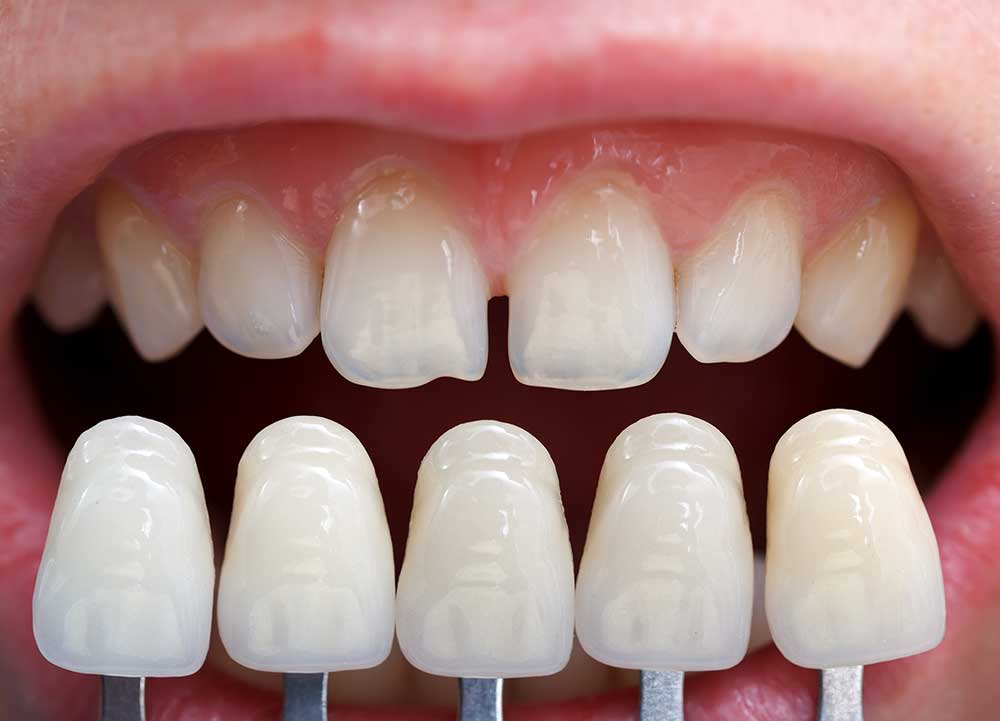
Laminate veneers are thin restorations applied primarily to the front surfaces of teeth to address differences in colour, shape and certain aspects of position. They are also known as porcelain veneers. In suitable patients, ceramic laminate veneers may allow a substantial amount of natural tooth tissue to be preserved.
However, not every tooth is suitable for a veneer. Existing tooth structure, the amount of enamel, bite relationships and aesthetic expectations affect treatment planning.
Preserving healthy tooth tissue is one of the fundamental priorities in my approach. I therefore do not believe that every tooth should be covered simply because an aesthetic change is wanted. The suitability of more conservative options should be assessed first.
What Is a Laminate Veneer?
A laminate veneer is a thin restoration bonded to the front surface of a tooth.
Ceramic laminate veneers can be prepared to reproduce the aesthetic characteristics of a natural tooth.
These restorations can change a tooth's colour, shape, length or surface characteristics to a certain extent.
However, a laminate veneer differs from a conventional crown that surrounds the entire tooth.
It generally covers the front surface and, depending on the design, certain parts of the incisal edge.
It may therefore be possible to apply it with less removal of tooth tissue in some patients.
When Are Dental Veneers Used?
Laminate veneers may be considered for various aesthetic concerns.
For example:
- Colour differences that cannot be adequately corrected by whitening;
- Minor shape irregularities in front teeth;
- Certain gaps between teeth;
- Limited fractures of front teeth;
- Differences in tooth size;
- Certain enamel development defects;
- Replacement of existing aesthetic restorations.
However, laminate veneers may not be the first choice for each of these situations.
For example, a small gap between teeth may be corrected with orthodontic treatment or a composite restoration in suitable cases.
Treatment options should therefore be assessed together.
Who Is Suitable for Laminate Veneers?
Existing tooth structure matters when considering veneers.
In particular, sufficient enamel may provide an advantage for bonding a ceramic restoration to the tooth.
However, enamel quantity is not the only determining factor.
Existing restorations, the extent of fractures, bite relationships and oral hygiene should also be assessed.
Patients with active decay or gum disease may need these problems treated first.
For patients with a significant clenching habit, the forces to which veneers will be exposed should be assessed separately.
What Is Assessed Before Dental Veneers?
Existing tooth structure
The amount of sound enamel and dentine is examined.
Dentine is the hard dental tissue beneath the enamel.
Tooth shape and position
Tooth dimensions, inclinations and relationships with one another are assessed.
Gum health
Healthy gum tissues matter for marginal fit and long-term maintenance of restorations.
Bite relationships
Particularly for front-tooth restorations, tooth contacts during lower jaw movements are assessed.
The patient's expectations
The extent to which the desired colour, shape and appearance can be achieved within existing biological conditions is assessed.
How Are Laminate Veneers Made?
1. Examination and planning
The existing condition of the teeth is examined.
The patient's expectations and treatment alternatives are assessed.
2. Design
The planned tooth shapes and dimensions are determined.
Digital design or physical models may be used when needed.
3. Tooth preparation
Depending on the restoration design, some tissue may need to be removed from the tooth surface.
In certain suitable cases, treatment without preparation or with very limited preparation may be possible.
4. Taking impressions
Impressions of the prepared teeth may be taken using conventional or digital methods.
5. Preparing the ceramic restorations
Veneers are prepared in a laboratory.
Colour, surface characteristics and anatomical form are planned.
6. Try-in
The fit, colour and aesthetic characteristics of the restorations are assessed.
7. Bonding
Ceramic restorations are bonded to the teeth using appropriate surface preparation and an adhesive cementation protocol.
Adhesive cementation is the process of bonding a restoration to a tooth using specialised bonding systems.
8. Final checks
Bite relationships and the surface characteristics of the restorations are checked.
How Much Tooth Preparation Is Needed for Veneers?
There is no single answer that applies to every patient.
The amount of tissue that needs to be removed depends on the existing tooth's position, colour and shape, and the thickness of the planned restoration.
Very limited preparation may be sufficient in some cases.
Other cases may require more extensive preparation.
What matters to me is avoiding unnecessary loss of healthy tooth tissue while pursuing an aesthetic goal.
I therefore believe that conservative treatment options should be considered wherever possible.
How Long Does Veneer Treatment Take?
Treatment duration depends on the number of restorations and the patient's existing oral health.
Planning, tooth preparation, impressions, laboratory work and bonding may require separate appointments.
Additional gum treatment or other preparatory procedures may extend the process.
Why Does Function Matter for Dental Veneers?
Front teeth do more than contribute to smile aesthetics.
They are also important for cutting food and producing certain speech sounds.
Contacts between front teeth may also occur during certain lower jaw movements.
Changing the lengths or shapes of front teeth can therefore affect existing tooth contacts.
For example, simply restoring lost tooth length may not be sufficient for a patient with significant front-tooth wear.
The causes of wear and the forces to which the restorations will be exposed should also be assessed.
However, tooth wear should not always be assumed to result from a bite disorder.
Erosion, mechanical wear, clenching and other factors may also play a role.
In my Biofunctional Dentistry approach, the priority is to distinguish between these factors and develop the correct treatment plan.
What Are the Advantages of Laminate Veneers?
Preservation of tooth tissue
In suitable cases, less tooth tissue may need to be removed than for full crowns.
Aesthetic characteristics
Ceramic materials can be used to prepare restorations that approach the appearance of natural teeth.
Colour stability
Suitable ceramic materials may offer greater colour stability than some composite restorations.
Individual design
Tooth shapes and dimensions can be planned according to the patient's aesthetic needs.
What Are the Risks of Laminate Veneers?
Laminate veneer treatment is not entirely free of risk.
Possible problems include:
- Fracture of the ceramic restoration;
- Debonding of the restoration;
- Tooth sensitivity;
- Problems related to marginal fit;
- Gum irritation;
- Failure to meet aesthetic expectations.
Procedures involving removal of tooth tissue are also not completely reversible.
It is therefore important to assess alternatives before deciding on treatment.
What Are the Alternatives to Dental Veneers?
Tooth whitening
This may be considered when the concern relates solely to tooth colour.
Composite bonding
This can be used for small changes in shape and limited aesthetic adjustments.
Orthodontic treatment
This may be a suitable option for problems involving tooth position.
All-ceramic crowns
These may be considered when a tooth has more extensive tissue loss or structural problems.
The appropriate method is determined after examination.
What Care Is Needed After Dental Veneers?
Laminate veneers require regular cleaning.
Toothbrushing and interdental cleaning should continue.
Avoid breaking hard objects with the teeth.
A protective appliance may be considered for some patients who clench their teeth.
Regular reviews of the restorations and surrounding tissues are important.
When Should You Contact Your Dentist?
Contact your dentist if a veneer fractures, becomes mobile, develops a sharp edge, causes persistent sensitivity or produces significant discomfort when biting.
What Affects the Cost of Dental Veneers?
Treatment cost depends on the number of teeth treated, the ceramic material, laboratory processes and additional procedures required.
As each patient's tooth structure and treatment needs differ, the exact cost can be determined after examination.
Frequently Asked Questions
1. Are laminate veneers and porcelain veneers the same thing?
Yes. The term porcelain veneer generally refers to ceramic laminate veneer restorations.
2. Do teeth need preparation for veneers?
Some patients need limited preparation. No-preparation applications may also be possible in suitable cases.
3. Can dental veneers fracture?
Yes. Although ceramic veneers are durable, they may fracture because of excessive forces or trauma.
4. How many years do dental veneers last?
Lifespan depends on the characteristics of the restoration, oral care and individual factors. A definite lifespan cannot be guaranteed.
5. Do dental veneers turn yellow?
Ceramic restorations generally have good colour stability. However, surface staining or colour changes around a restoration can occur.
6. Can dental veneers harm the gums?
Appropriately planned restorations may be compatible with gum health. However, poor marginal fit and inadequate cleaning can cause problems.
7. Can patients who clench their teeth have veneers?
Some patients can. However, the risks of fracture and bonding problems need assessment.
8. Are dental veneers or zirconia crowns better?
The two treatments have different applications. Existing tooth structure and restorative needs are decisive.
9. Can dental veneers be removed?
Yes. However, removal can damage the restoration. If a tooth has been prepared, returning completely to its original condition may not be possible.
10. Can you eat normally after dental veneers?
Everyday eating can continue with appropriately completed restorations. However, breaking hard objects with the teeth can damage them.