

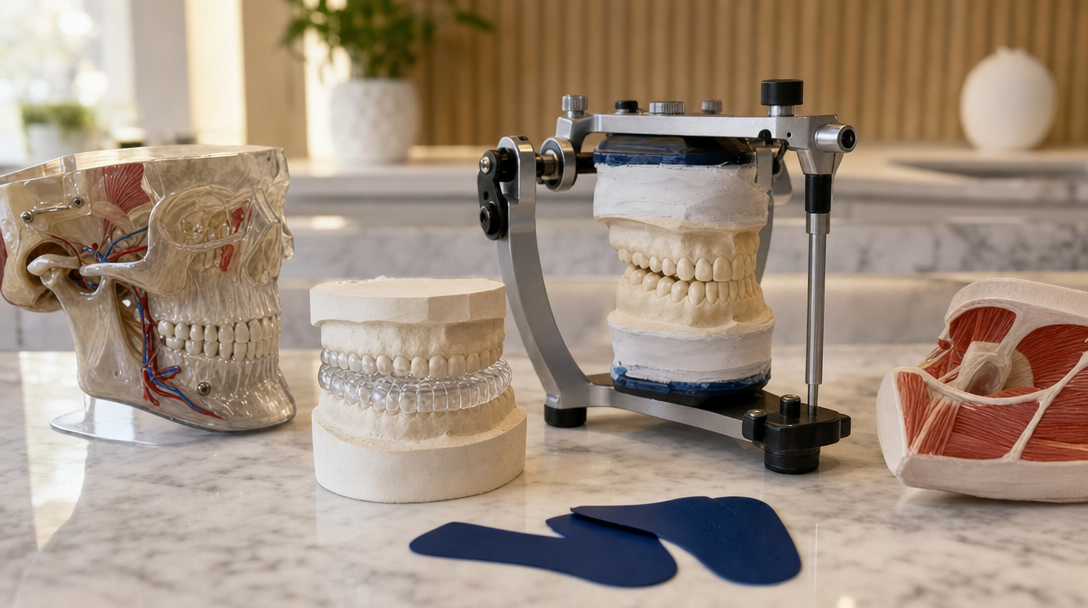
Jaw joint pain can significantly affect everyday quality of life. Pain may be felt in front of the ear, at the jaw angle, temple or face while speaking, eating, yawning, chewing gum, clenching or waking. Patients may describe pain near the ear, waking with a tired jaw, pain on opening, aching while chewing, or a jaw that makes noises and sometimes hurts.
Assessment seeks the cause by considering teeth, muscles, the joint, bite and clenching signs together, alongside relief of pain.
The source is not always the joint. Muscles, bite factors, clenching and other medical conditions can produce similar pain.
Are Jaw Noises Related to Pain?
Noises are common, but accompanying symptoms matter more than the noise alone. Assessment distinguishes clicking from grating or crepitus and checks restricted opening, locking, deviation, clenching signs and recent changes. A painless longstanding stable click may be monitored. Pain, locking or restricted opening warrants more detailed assessment. Findings are interpreted together to distinguish cases suitable for observation from those needing further investigation, helping avoid unnecessary anxiety and intervention.
Can Bite Problems Contribute?
Occlusion is the relationship between upper and lower teeth. Imbalance, high fillings or crowns, premature contacts and unsuitable restorations may load muscles and the joint in some patients. Assessment considers high restorations, a tooth contacting first, a changed-bite sensation, excessive back-tooth loading during sideways movement, loss of front or canine guidance, missing-tooth-related changes, one-sided loading and adaptation after full-mouth restoration. The bite is one component of a multifactorial picture. An unnoticed imbalance may contribute to loading and should be assessed with the rest of the system.
Can a High Filling or Crown Cause Pain?
A high restoration may create premature contact. The muscles and joint respond when one tooth contacts before others. Symptoms may include biting sensitivity, discomfort when chewing, a changed-bite sensation, fatigue, temple pain or joint tenderness. Pain following a new restoration may indicate contact mismatch, so the bite should be checked. Assuming every patient will simply adapt is inappropriate. Even a small excess contact can produce a marked response in sensitive patients. Pain may reflect the whole system’s response rather than one tooth alone. Early adjustment may relieve these complaints promptly in some cases.
Can Clenching Cause Joint Pain?
Clenching or bruxism is commonly associated with jaw pain because muscles and the joint may experience stronger and more prolonged forces than in ordinary chewing. Signs can include morning pain, a firm masseter, temple pain, wear, enamel cracks, sensitivity, joint tenderness and head and neck tension. Clenching may contribute without explaining every case. The joint, muscles and bite should be assessed together, with a guard or splint planned where appropriate. A guard may be insufficient when joint pain or bite uncertainty is present. Protection from loading and muscle comfort are important goals that can support pain relief and long-term tooth protection.
Can Missing Teeth Contribute?
Missing teeth can alter chewing balance, particularly after longstanding loss. Opposing teeth may overerupt, adjacent teeth may tilt, and one-sided chewing or imbalanced contacts may develop. Chewing efficiency, muscle balance and joint loading can change. Not every missing tooth causes jaw pain, but missing teeth and chewing patterns should be assessed where pain is present. Longstanding loss may shift loads to one side and increase fatigue there. Replacing missing teeth or restoring chewing balance may therefore become part of planning.
Are Orthodontic Problems Related?
Some bite or alignment problems affect force distribution, but their relationship with TMJ pain is not always simple or one-directional. Deep bites, open bites, crossbites, severe crowding and tilting associated with missing teeth may affect contacts and guidance in some patients. An orthodontic finding does not automatically establish the cause of pain, and many people with bite problems have no TMJ symptoms. These factors should be considered alongside muscles and joint findings. Orthodontic assessment may form part of the plan when pronounced bite problems coexist with jaw pain.
Conclusion — Understanding the Cause of Jaw Joint Pain
Pain may relate to the TMJ, muscles, clenching, bite, high restorations, disc problems, trauma, gum or hard-food habits, one-sided chewing, stress, sleep quality, wear, missing teeth or head and neck tension. Dental, muscle, ear, sinus, neck and neurological pain may be felt similarly in front of the ear. Understanding the cause requires assessment of teeth, muscles, joint, bite and clenching signs together.
Managing jaw joint pain starts with understanding the loading and underlying source, alongside where the pain is felt.
Clinician’s note: This article provides general information. Jaw pain can relate to joint, muscle, dental, bite, restoration, disc, trauma, habit, sleep, posture or other medical factors. Not all jaw pain indicates joint disease. Diagnosis and treatment planning require clinical examination alongside assessment of teeth, joint, muscles, bite, restorations, clenching signs and history.
Frequently Asked Questions
What causes jaw joint pain?
It may relate to TMJ problems, clenching, chewing muscle pain, bite imbalance, high fillings, disc problems, trauma, gum chewing, hard foods, stress or head and neck tension.
Does all jaw pain come from the TMJ?
No. Muscles, teeth, ears, sinuses, the neck or neurological conditions can cause similar pain. Clinical examination is needed.
Can clenching cause jaw joint pain?
Yes. Clenching can load the chewing muscles and joint and may accompany morning pain, muscle stiffness, tooth wear and headaches.
Do jaw noises cause pain?
A noise alone may not cause pain. Noises with pain, locking or restricted opening require TMJ assessment.
Can a high filling cause jaw pain?
In some patients, a high filling or crown creates premature contact and contributes to muscle fatigue, tooth sensitivity and jaw discomfort. The bite should be checked.
Can jaw joint problems accompany headaches?
Chewing muscle tenderness and clenching may accompany temple headaches, but not every headache comes from the TMJ.
Is a night guard enough?
Not always. It may protect teeth, while joint pain, muscle tenderness or bite uncertainty may require a splint or another approach.
When should I seek an examination?
Seek assessment for locking, limited opening, pain that prevents chewing, pain after trauma, painful noises, persistent morning pain or a changed-bite sensation.