

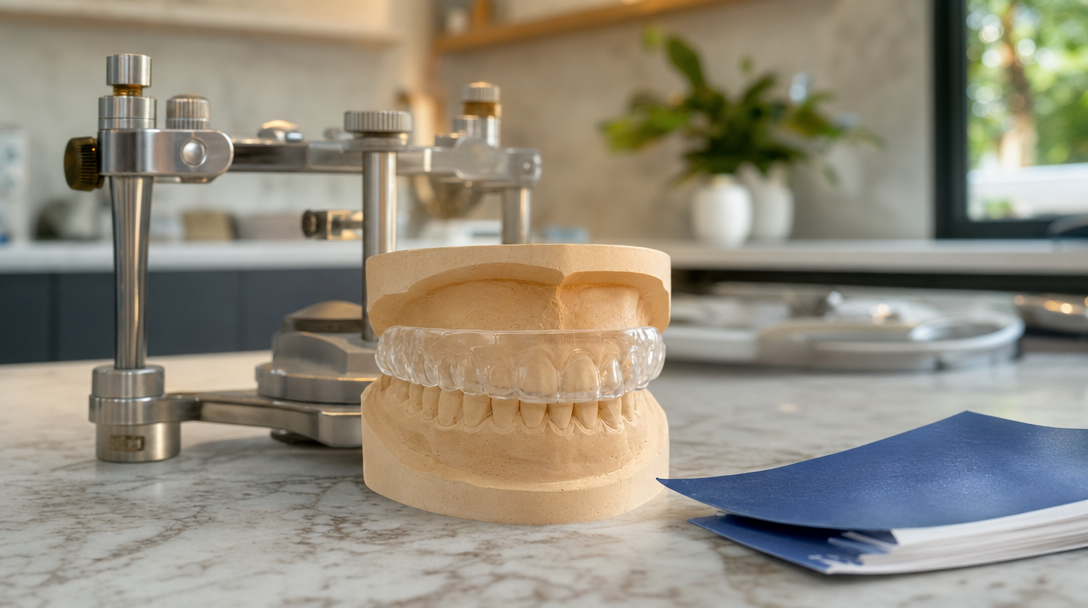
Splint treatment uses custom intraoral appliances to make the relationship between the teeth, chewing muscles and jaw joint more controlled. It is commonly considered for clenching, bruxism, jaw pain, muscle tenderness, joint noises and bite imbalance.
A splint is often confused with a night guard. A night guard is mainly protective, whereas splint design also aims to assess tooth contacts, lower jaw position, muscle responses and joint loading. Separating the teeth is only one part of its role.
Splint treatment is a clinical process that assesses the chewing system as a whole.
The following questions guide treatment.
- Why does the patient clench?
- Are the jaw muscles tender?
- Is there joint noise, pain or locking?
- Is there tooth wear?
- Is the bite balanced?
- Are there premature contacts?
- Are restorations at risk?
- Is the goal protection, relief or stabilisation?
The answers determine design, duration and follow-up.
What Does a Splint Do?
Its role varies. It may protect teeth, help chewing muscles work more comfortably, support control of joint loading or test responses before definitive treatment.
Possible uses include the following.
- Reducing damage from clenching and grinding
- Helping slow tooth wear
- Protecting fillings, crowns, veneers and zirconia
- Supporting load control in implant-supported prostheses
- Helping reduce excessive jaw muscle activity
- Reducing morning fatigue
- Supporting management of joint pain
- Controlling bite contacts
- Assessing lower jaw position before treatment
- Functionally testing the system before full-mouth rehabilitation
Responses differ between patients. Identical designs do not produce identical results, so planning is individual.
When Is Splint Treatment Used?
It may be considered for the following chewing-system symptoms or treatment needs.
- Clenching, bruxism and grinding
- Jaw pain, muscle pain and morning fatigue
- Temple pain
- Jaw noises, clicking or locking
- Difficulty opening the mouth
- Tooth wear and broken fillings or crowns
- Bite imbalance
- Assessment before full-mouth rehabilitation
- Protection of aesthetic restorations and implant-supported prostheses
It is not automatically prescribed for every case. The source of pain and the underlying problem should first be assessed.
Does It Stop Clenching?
Most patients do not stop clenching completely, but a splint may help limit damage and manage the chewing system. Clenching is multifactorial. Stress, sleep quality, central nervous system activity, bite, muscles, joint factors and daytime habits can contribute. A splint does not remove every factor, but may offer the following support.
- Protection for teeth and restorations
- Reduced muscle loading
- Management of joint loading
- More controlled bite contacts
- Information about the clenching pattern
It is therefore a valuable tool, although not always a lasting solution on its own.
Can It Help Jaw Pain?
It may reduce pain in selected patients, particularly where excessive chewing muscle activity, clenching or bite loading is involved.
Other causes include problems inside the joint, disc disorders, inflammation, dental pain, ear or sinus conditions, trauma, neurological pain, and neck or posture-related problems. The source should be identified before treatment. Advanced intra-articular problems may require additional approaches.
How Does It Affect the Jaw Joint?
The joint connects the lower jaw to the skull and works with the bite and chewing muscles. Imbalance can produce pain, noises, fatigue or restricted movement.
In some patients, a splint helps control loading, especially where muscle-related clenching and bite loading are present. It may help reduce joint loading, ease muscle-related pressure, support more stable closure, reduce overload during sleep and relieve strain during painful episodes.
The role and response vary with disc displacement, locking, degeneration or inflammation. TMJ findings therefore require examination.
Does It Relax Muscles?
A correctly designed splint may help the chewing muscles work more comfortably. It can be considered for masseter or temporalis tenderness, tension or morning fatigue.
Contributing factors may include clenching, daytime tooth contact, bite imbalance, joint disorders, stress, one-sided chewing, unsuitable restoration contacts and head and neck posture.
A splint changes the mechanical environment in which muscles work rather than directly curing them. It may be helpful alone or alongside physiotherapy, exercise, stress management or other support.
How Does a Splint Differ from a Night Guard?
Both may look similar, fit inside the mouth and be used for clenching or bruxism. Their design and purpose can differ. Night guards generally reduce tooth damage. Splints additionally consider contacts, jaw movements, muscle responses and joint relationships.
A night guard mainly focuses on protection. A splint may also help manage the muscle, joint and bite relationship.
Splint treatment may therefore be more appropriate for some patients with jaw pain, TMJ problems, pronounced clenching or bite imbalance.
How Is a Splint Made?
A splint should be custom-made. Ready-made guards cannot replace this treatment because success depends on bite design and review as well as fit.
- Clinical examination assesses teeth, gums, restorations, wear, the joint and muscles.
- Joint and muscle assessment checks opening and closing, noises, pain, deviation, locking and tenderness.
- Bite analysis evaluates contacts, premature contacts and guidance during sideways movement.
- Impressions or digital scans record the teeth precisely.
- Design determines the arch, thickness, hardness and contact relationships.
- Intraoral fitting checks seating, margins and comfort.
- Occlusal adjustment organises contacts on the appliance, an important clinical step.
- Follow-up reassesses muscles, joint and contacts, with adjustments as needed.
Why Is Bite Adjustment Important?
Fit alone is insufficient. The way opposing teeth contact the splint matters. Uneven contacts can cause tooth pressure, increased jaw pain, muscle fatigue, one-sided wear, an uncomfortable bite, increased joint loading or breakage.
Correct adjustment can distribute force more evenly and support comfort and effectiveness. Treatment includes intraoral checks and adjustment rather than ending with laboratory manufacture and delivery.
Is It Made for the Upper or Lower Jaw?
Either arch may be used. The choice depends on anatomy, alignment, missing teeth, restorations, bite, joint status and goals. Upper splints may be more stable in some cases and lower splints more comfortable in others. Correct design is crucial. An unsuitable upper splint can cause discomfort, while a well-designed lower splint can work well. The decision is individual.
Should It Be Hard or Soft?
Splints are commonly made from hard materials because contacts can be adjusted more precisely. Soft appliances can feel comfortable, but some patients with severe bruxism chew them more, potentially increasing muscle activity.
Hard splints offer controlled contact adjustment, better bite balance, potentially greater durability in severe bruxism, clearer monitoring of muscle and joint responses, and suitability for therapeutic use. They still require correct manufacture. Poorly fitting hard splints can cause pressure or jaw discomfort. Material choice is individual.
How Long Does Treatment Take?
Some patients need a few weeks of use and review, others months of regular follow-up, and some long-term protection. Duration depends on clenching severity, pain duration, muscle tenderness, joint findings, wear, restorations, goals, adherence and response at reviews.
Treatment is a process. The full response is not established on delivery day. Muscle and joint responses need monitoring.
How Many Hours Should It Be Worn?
The schedule is individual. Some splints are worn only at night, while short daytime use may be advised in some cases. The clinician makes this decision after assessment. Patients should not independently increase or decrease use, especially with TMJ problems.
Is Definitive Treatment Needed Afterwards?
A splint may be sufficient alone or serve as an assessment stage before definitive treatment. Further treatment may be needed for lost vertical dimension, advanced wear, pronounced bite problems, repeatedly broken crowns, planned full-mouth rehabilitation or implant-supported prosthesis problems, or when testing function before restoration.
The response shows whether muscles settle, jaw position is stable, the patient tolerates the relationship and pain decreases. This information supports definitive planning.
Does It Straighten Teeth or Correct Jaw Structure?
A splint is not orthodontic. It does not move or align teeth or correct crowding. Its role is temporary organisation of contacts, management of loading and assessment of the chewing system.
It does not permanently correct skeletal jaw abnormalities, a retruded or protruding jaw, or serious orthodontic problems. It may help muscles work more comfortably, reduce loading and allow assessment of a more comfortable lower jaw position in some patients.
What If Pain Increases?
A mild unfamiliar sensation may occur, but marked pain, pressure, increased jaw pain or feeling worse on waking should not be regarded as normal. A review is needed if the appliance is too tight, causes tooth pain, increases jaw, joint or head pain, rubs the gums, moves in the mouth, breaks quickly or creates a changed-bite sensation.
Adjustment or reassessment of the plan may be needed.
Why Is Follow-up Important?
Contacts, muscle responses and symptoms can change during use. Reviews check seating, contacts, wear marks, tenderness, joint pain, opening, morning fatigue, tooth pressure and comfort. Adjustments are made where needed.
An unmonitored splint may fail to help or cause discomfort. Treatment therefore continues beyond delivery.
Who May Need a Different Approach?
A splint may be unsuitable or insufficient alone in some patients. Careful assessment is needed with active infection, untreated gum problems, very mobile teeth, suspected severe sleep apnoea, advanced joint pathology, acute post-trauma conditions, suspected neurological pain, severe psychologically or sleep-related bruxism, inability to tolerate an appliance or poor oral hygiene.
The underlying problem may need treatment first, or multidisciplinary assessment may be required.
Its Role in a Biofunctional Approach
A splint is a clinical tool for understanding and managing the chewing system as well as protecting teeth. Planning considers teeth, joint, chewing muscles, bite, wear, restorations, implants, chewing pattern, posture, head and neck relationships and habits together.
The aim is to understand why the system is under strain and establish a better treatment sequence.
Conclusion — What Is Splint Treatment?
Splint treatment is personalised intraoral appliance therapy used for clenching, muscle pain, joint disorders, bite imbalance and restoration protection. Its controlled design can help support or assess the muscle, joint and bite relationship. Examination, appropriate design, contact adjustment and regular follow-up are needed because treatment varies individually.
Splint treatment is controlled, personalised appliance therapy to protect, relieve and assess the chewing system.
Clinician’s note: This article provides general information. Splints require individual planning. Clinical examination, bite analysis and jaw joint assessment are needed before treatment where clenching, jaw pain, joint noises, restricted opening, muscle tenderness or advanced wear are present.
Frequently Asked Questions
What is splint treatment?
It is supportive treatment using custom intraoral appliances for clenching, jaw pain, tender jaw muscles and TMJ problems.
Is a splint the same as a night guard?
Not exactly. A night guard mainly protects teeth. A splint can be designed for more controlled assessment of the muscle, joint and bite relationship.
Does a splint stop clenching?
It does not completely eliminate clenching in most patients, but may help reduce its harmful effects and manage muscle and joint loading.
Can a splint help jaw pain?
It may help muscle-related or clenching-related pain. The cause should be identified first because not all jaw pain responds to a splint.
How long is a splint used?
Duration varies. Some patients need weeks, others months or longer.
Does a splint straighten teeth?
No. It is not an orthodontic appliance and does not move teeth or correct crowding.
Does a splint correct the jaw?
It does not permanently change jaw structure, but may help manage muscle and joint loading and relieve strain in some patients.
What if a splint causes pain?
Tooth pressure, increased jaw pain or headache requires a review. The appliance may need adjustment.