

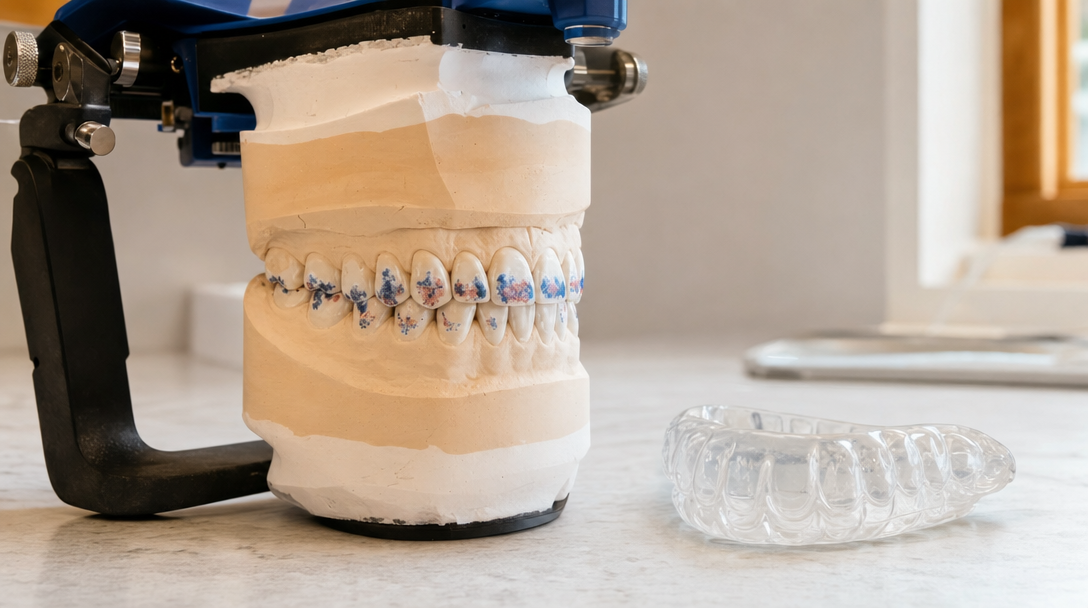
Bruxism is involuntary clenching or grinding of the teeth, or excessive jaw muscle activity outside normal function. It is commonly called teeth clenching or teeth grinding.
It is more than a simple dental habit. It may involve the teeth, chewing muscles, jaw joint, bite, sleep quality, stress and the longevity of restorations. Some people grind during sleep, some clench forcefully without making a sound, and others tense their jaw unknowingly while awake.
Bruxism can take different forms and does not affect every patient in the same way.
It may be recognised only through tooth wear in some patients. In others, it presents as jaw pain, headache, morning fatigue, broken crowns or jaw joint noises.
What Does Bruxism Mean?
Bruxism refers to chewing-system muscle activity outside normal chewing, speaking and swallowing. This may involve clenching, grinding or repetitive contraction of the lower jaw. Teeth normally should not remain in contact for long periods during the day. With bruxism, contact may last longer or involve greater force, placing loads on the teeth, muscles and joint over time.
Key features include the following.
- It is involuntary and may occur during sleep or while awake.
- It can be noisy or silent.
- Patients do not always notice it.
- It may damage teeth and restorations.
- Muscle and joint symptoms may accompany it.
- More than one contributing factor may be involved.
Assessment therefore requires examination of the teeth, muscles, jaw joint and bite as well as asking about clenching.
Is Bruxism the Same as Clenching?
Bruxism is a broader term that includes clenching. During clenching, the upper and lower teeth press firmly together, possibly without sliding or sound. Grinding is another form in which the teeth rub against one another, often producing an audible noise.
Clenching describes forceful pressure, grinding describes sliding contact, and bruxism is the overall term. One form may predominate or both may occur together. Treatment planning should consider the distinction because tooth marks, muscle effects and appliance needs can differ.
What Is Sleep Bruxism?
Sleep bruxism is clenching or grinding during sleep. Patients are often unaware of it. A partner or family member may hear grinding, while silent clenching may produce no sound. Signs may include the following.
- Morning jaw fatigue and headache
- Tension around the temples
- Sensitive or worn teeth
- Grinding sounds during sleep
- Firm jaw muscles
- Difficulty opening in the morning
- Wear or breakage of a night guard
- Broken fillings or crowns
Trying consciously not to clench is insufficient during sleep. Protection of the teeth, assessment of muscle and joint loading, and a night guard or splint may be needed.
What Is Awake Bruxism?
Awake bruxism involves clenching, keeping the teeth in contact or unnecessarily tensing the jaw muscles while awake. It often relates to awareness. It may happen at a computer, when driving, under stress, during exercise or intense concentration.
Patients can learn to recognise this activity. At rest the teeth should be apart, even when the lips are together.
Lips together, teeth apart.
A night guard alone may be insufficient. Awareness, stress management, posture adjustments, muscle relaxation and, where needed, bite assessment are important.
How Can Bruxism Be Recognised?
Patients may be unaware of bruxism for years, especially when sleep clenching is silent. Possible signs include the following.
- Tooth wear, shorter tooth edges and enamel cracks
- Tooth sensitivity
- Broken fillings, crowns or zirconia restorations and veneer problems
- Morning jaw fatigue, sore jaw muscles, temple pain or headaches
- Jaw joint noises or discomfort around the ear
- Tongue-edge indentations or bite lines inside the cheeks
- Worn or broken night guards
These findings raise suspicion, but clinical examination is needed for assessment.
What Causes Bruxism?
There is no single cause. Several factors often contribute together.
- Stress and psychological tension may particularly increase awake clenching.
- Sleep quality may matter, including interrupted or restless sleep and some sleep disorders.
- Central nervous system activity and muscle responses during sleep may play a role.
- Bite factors, such as premature contacts, high restorations or imbalanced contacts, may disturb the system.
- Jaw muscle activity, especially in the masseter and temporalis, may increase symptoms.
- Jaw joint problems may coexist with bruxism.
- Lifestyle habits, including caffeine, alcohol, smoking, extensive screen use and poor sleep routines, can affect the picture.
- Some medicines may be associated with bruxism. Concerns should be discussed with the prescribing clinician.
The contributing factors differ between patients and require individual assessment.
Is Stress the Only Cause?
No. Stress is important but does not explain every case. Bruxism involves sleep, muscle activity, the nervous system, bite, jaw joint and habits.
Clenching can continue even when stress decreases. Daytime tooth contact, sleep disorders, bite imbalance, excessive jaw muscle activity, TMJ problems, restorative risks, breathing problems or advanced tooth wear may be present. Advice to avoid stress alone is therefore insufficient. The whole system should be assessed.
How Can Bruxism Damage Teeth?
Bruxism can load teeth beyond ordinary chewing forces. Repetitive overnight clenching and grinding may wear enamel. Possible effects include the following.
- Tooth wear, shortening of front teeth and flattening of back teeth
- Enamel cracks and fractures
- Sensitivity, including around the necks of teeth
- A sensation of loose teeth
- Fracture risk in root-treated teeth or teeth with large fillings
Flattened front tooth edges and broad wear areas on back teeth are important findings.
Can Bruxism Damage Crowns, Zirconia and Veneers?
Yes. It may affect restorations as well as natural teeth. Possible problems include broken fillings, cracked crowns, zirconia fractures, porcelain chipping, fractured or detached veneers, ceramic fractures in implant-supported prostheses, loose screws, wear of opposing teeth and stress at restoration margins.
When aesthetic treatment, zirconia, veneers, implant-supported prostheses or full-mouth rehabilitation is planned, a protective guard or splint should be considered where bruxism is present. Restoration occlusion, front tooth guidance, sideways movements and chewing forces must also be planned correctly.
Can Bruxism Cause Jaw Pain?
Yes. Excessive jaw muscle activity can cause pain, fatigue, temple discomfort and sometimes discomfort around the ear. The masseter, temporalis and pterygoid muscles are commonly involved. Prolonged activity can produce tenderness and pain.
Patients may describe morning fatigue, pressure at the temples, firmness at the jaw angle, tiring when chewing or pain that increases with clenching. Other dental, joint, ear, sinus, neurological or musculoskeletal causes of jaw pain also require consideration.
Can Bruxism Affect the Jaw Joint?
Bruxism may increase jaw joint loading, but not every patient develops a joint disorder. Some have heavy clenching without joint symptoms, while others develop noises, pain, deviation or locking.
Associated TMJ findings may include clicking, pain in front of the ear, deviation on opening, locking, restricted opening, joint pain during chewing or morning tenderness. These findings may call for more controlled splint therapy and joint assessment in addition to protection with a guard.
Can Bruxism Contribute to Headaches?
It may contribute in some patients, particularly through overactivity of the temporalis muscle. Associated findings can include morning headache, temple tension, jaw fatigue, sensitive teeth, a firm masseter and neck tension.
Migraine, sinus problems, eye conditions, neurological disorders, neck-related pain and blood pressure problems can also cause headaches. Differential diagnosis is important.
Does Bruxism Cause Gum Recession?
Bruxism is not the only cause of recession. Gum disease, incorrect brushing, thin gum tissue, tooth position, age and genetics are more frequent factors. Excessive tooth loading may coexist with sensitivity at tooth necks, enamel loss and recession in some patients.
Both periodontal health and bite loading should therefore be assessed in patients with recession and bruxism.
How Is Bruxism Treated?
The type, severity and damage to the chewing system are assessed first. Treatment options vary individually.
- Night guards help protect teeth and restorations, especially during sleep.
- Splint therapy can support more controlled assessment of the muscle, joint and bite relationship.
- Daytime awareness is important in awake bruxism, including learning to keep teeth apart.
- Bite analysis considers high restorations, premature contacts and imbalance.
- Muscle relaxation and exercise may help selected patients.
- Physiotherapy may be needed where neck, posture and musculoskeletal factors coexist.
- Restorative treatment may be required for advanced wear, fractures or loss of vertical dimension.
- Sleep and lifestyle assessment considers sleep quality, caffeine, stress and breathing factors.
The aim is to manage damage to teeth, muscles and the joint as well as the clenching activity.
What Does a Night Guard Do?
A night guard reduces direct tooth-to-tooth damage during clenching and grinding. It may help reduce wear, support prevention of enamel cracks, reduce sensitivity, protect fillings, crowns, veneers, zirconia and implant-supported prostheses, and reduce muscle loading or morning fatigue in some patients.
It does not always eliminate bruxism. A patient may continue clenching on the appliance, which then acts as a protective interface.
When Might a Splint Be Needed?
A night guard may suffice when bruxism is mild and protection is the main goal. A more controlled splint may be considered for jaw pain, joint noises, marked muscle tenderness, pronounced morning fatigue, advanced wear, repeatedly broken crowns, an ineffective guard, quickly broken appliances, bite imbalance or planned full-mouth rehabilitation.
A splint can both protect teeth and support assessment of the muscle, joint and bite relationship.
What Happens If Bruxism Is Left Untreated?
Damage varies between patients. Longstanding unmanaged bruxism may lead to wear and shorter teeth, enamel cracks, sensitivity, fractures, broken fillings and crowns, veneer or zirconia problems, implant-supported prosthesis problems, jaw muscle pain, temple pain, headaches, joint symptoms, loss of vertical dimension, aesthetic changes or less comfortable chewing.
Not every patient experiences all these problems. Early assessment is important when signs are present.
When Should You See a Dentist?
Assessment is appropriate for morning jaw fatigue, grinding sounds, tooth wear, sensitivity, cracks, broken fillings or crowns, jaw pain, joint noises, temple pain, headaches, tongue-edge indentations, cheek bite lines, worn or broken guards, or a need for protection after smile design or implant treatment.
Early assessment may help reduce permanent dental damage.
Why Is Biofunctional Assessment Important?
Bruxism can affect teeth, muscles, the jaw joint and bite together. Biofunctional assessment considers sleep versus awake activity, the distribution of tooth wear, muscle tenderness, joint noises or pain, bite balance, restoration risks and whether previous guards helped.
This approach helps identify how bruxism affects the system and plan treatment more appropriately.
Conclusion — What Is Bruxism?
Bruxism involves clenching, grinding or excessive jaw muscle activity. It may occur during sleep or while awake and can affect teeth, muscles, the joint and restorations. Night guards or splints may help protect the system, but individual assessment of contributing factors and clinical findings is essential.
Managing bruxism involves assessing and protecting the whole chewing system.
Clinician’s note: This article provides general information. Patients with clenching, grinding, jaw pain, tooth wear, sensitivity, broken restorations or jaw joint symptoms should have their teeth, muscles, joint and bite assessed together. Treatment is planned individually.
Frequently Asked Questions
What is bruxism?
Bruxism involves teeth clenching, grinding or involuntary excessive jaw muscle activity. It may occur during sleep or while awake.
Is bruxism the same as teeth clenching?
Clenching is one form of bruxism. Bruxism is the broader term that includes both clenching and grinding.
How can bruxism be recognised?
Tooth wear, morning jaw fatigue, sensitivity, headaches, firm jaw muscles and broken fillings or crowns can be signs of bruxism.
What causes bruxism?
Stress, sleep quality, muscle activity, bite factors, jaw joint problems, daytime habits and some medicines may be associated with bruxism.
Is bruxism caused only by stress?
No. Stress is important, but sleep, muscles, the nervous system, bite and jaw joint may also be involved.
Can bruxism damage teeth?
Yes. It can contribute to tooth wear, enamel cracks, sensitivity, fractures and restoration problems.
Is a night guard enough for bruxism?
It may be sufficient for some patients. Jaw pain, TMJ findings, advanced wear or severe bruxism may require a splint and detailed assessment.
What happens if bruxism is left untreated?
Tooth wear, broken restorations, jaw muscle pain, headaches, jaw joint symptoms and less comfortable chewing may occur.